
Imagine if power tripped...
...and we reset the circuit with kindness

I had an extraordinary day in court yesterday, and not as a lawyer.
I was shocked to watch the staff of a major metropolitan traffic division, from the Judge down, treat a large number of defendants with kindness. The staff and the forum shall go unnamed lest I undermine their exercise in decency, since courts are not ‘supposed’ to work this way.
I happened to be visiting a close friend who needed to resolve a moving violation from 2012 to renew her license, in order to get insurance, in order to drive for her livelihood—one of many hurdles to rebuilding her life after years of torment and financial ruin by men. She wasn’t even aware of the citation from that fugue decade until the DMV referred her to the City’s collection agent, who informed her she had a warrant for a failure to appear and fines totaling $3,000.
My friend is white, U.S. born, and earning a good income again. She can manage the sum. I accompanied her to help her angle for a reduction and avoid traps which might compound instead of alleviate her dilemma, such as admitting she’s been driving for years on an out of state suspended license.
I exaggerated a bit above. She mostly works from home and drives for fun. She’s got friends in high places and has subsisted on their largesse and loaner vehicles for years while building herself back up. She’s trying to get clean on paper and legit behind the wheel of her own new car, not just trying to pass go without getting sent straight to jail or thrown off the board entirely.
The stakes were probably higher for her mostly brown-skinned, ESL-speaking (if that) fellow citation holders. For many of them, getting legit on paper is existential. That they even showed up in court says something about their straits, since the system makes it pretty easy to resolve one’s ticket online by paying the full fine. I wondered how many of them had to gamble they wouldn’t run into ICE in the corridor. I can’t imagine the terror of having to seek succor from one bureaucracy while trying to avoid the lions of another.
None of this is new or unusual in our predatory society, in so many ways still a barely civilized jungle. What was novel yesterday is that the court staff clearly understood all of this on a human level, and cared to model something different; something humane. It began with according everyone basic respect and dignity. Inviting and answering questions, not dismissing people with on-high refrains, like ‘you should have talked to a lawyer before you got here,’ or ‘sit down, be quiet, and wait till you're called.’
To be sure, court staff cannot dispense legal advice, nor is there time for such individualized attention. But it was how they declined. I heard the Sheriff’s Deputy/Bailiff gently assure a women, “you’ll be fine.” In a branch of the court where lawyers are seldom scene (the indigent have no right to appointed counsel for mere infractions—the bulk of traffic citations), the Deputy virtually acted as a defense advocate, inquiring just enough into the facts of people’s cases to present the exonerating ones to the Judge (such as, “the red light camera photo clearly does not depict the defendant,” or “he has evidence of his repairs”). The Judge often then would dismiss the case before the Deputy was finished speaking or the defendant could even make it to the podium.
The Deputy informed the crowd that staff wanted to keep it moving, and they did—but opposite from the way I’m used to seeing: not as a greased downhill skid toward convictions and fines, but in a way designed to maximize rights and dismissals.
At that the staff was amazingly well-oiled and efficient. The Deputy re-seated people in the courtroom before proceedings so as to remember and present their particular circumstances to the Judge. The two clerks kept it all straight, making corresponding minute entries in the record and generating the paperwork people needed, and delivering it to them in the hallway after the session ended.
When a clerk promised a defendant who had lost his paper fix-it ticket that she would print a copy for him for a cop to sign off on before he returned to court, I thought to myself, she’ll forget to do that.
She remembered.
The Judge squinted at his computer, scanning for procedural bases to drop cases, because, as he reminded the assemblage, he is not empowered to hear and decide disputed facts at a cattle call arraignment, where the purpose is only to receive pleas and set the “not-guilty” ones for trial.
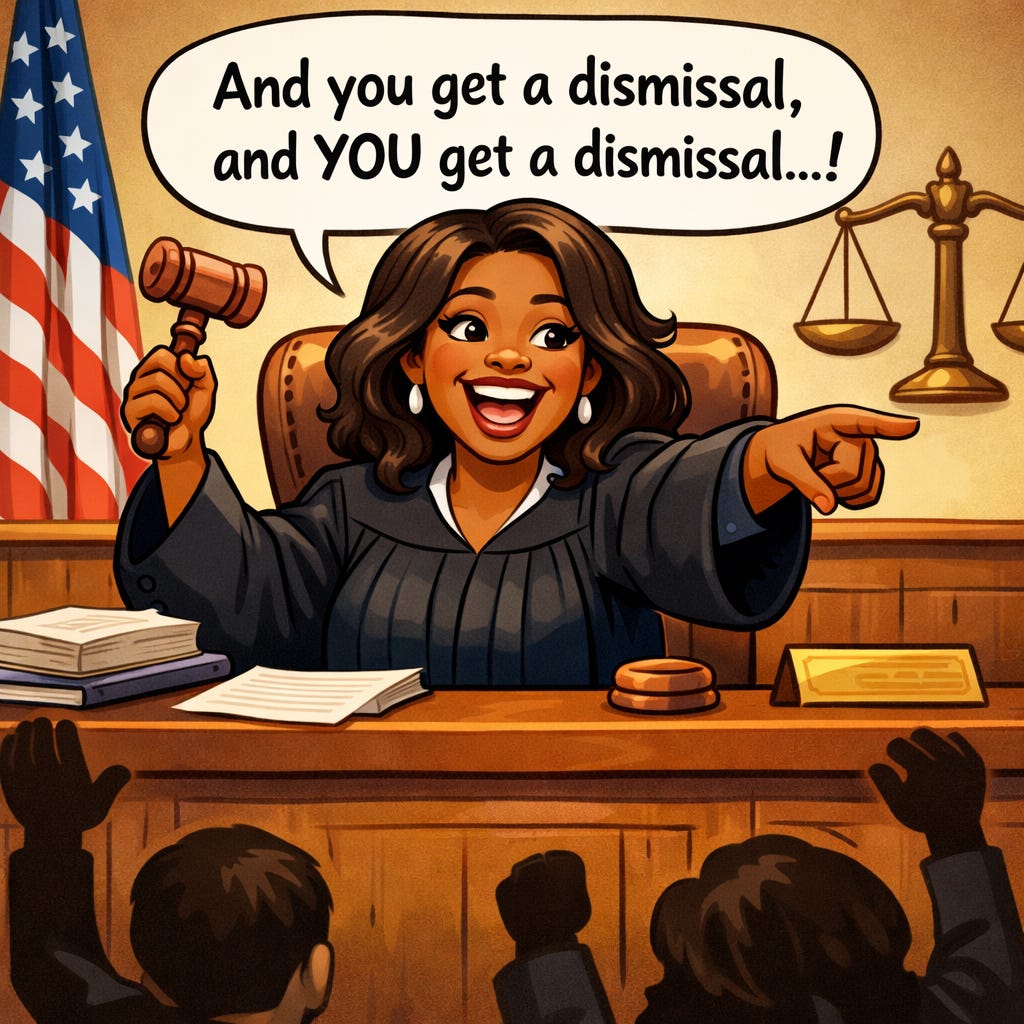
It clicked: The Deputy had reassured a defendant ‘you’ll be fine’ not to politely deflect her, but because he knew her case would be dismissed. My friend and I joked that we had stumbled into Oprah Court: “....And you get a dismissal, and you get a dismissal...”
This did not mean the Judge cast the law aside. It meant he leveled a courtroom full of defendants who lacked lawyers by supplying for them the sorts of procedural defenses any trained lawyer would know to assert for them. This is not heroics; it’s basic fairness. But in a society in which government is targeting masses of people who are just struggling to survive and keep their families intact—mirroring some of our darkest periods in history—such decency stands out in stark relief.
Beautiful too was that the group of citation holders responded in like kind: civilly, graciously, and by heeding the clear instructions, including to not waste everyone’s time arguing facts the Judge could not consider anyway.
I imagined I was watching a better society take shape in the most unlikely of venues—one I have always associated with the crass authoritarianism of the personalities it typically selects for, namely people who are not only comfortable with, but sometimes sadistically revel in, destroying the lives of others. (Until we treat that basic societal sickness, we will continue to suffer leaders who would sooner commit mass murder than allow the lens to linger on their personal and political failures. But that’s an essay for another day.)
When the one, obligatory, excess oxygen-sucking man clung to the podium to plead the details of his case, getting into more of a tête-à-tête with the Judge than anyone else, I whispered to my friend that this could be good for those who followed him. If you sit through a court session processing a large number of people, you will often see the judge lower the boom on the standout rude or annoying one, then compensate by showing extra solicitude to those who follow. I predicted that the Judge was about to hammer him.
Wrong again. The Judge practically steered the man through his own self-sabotaging minefield and illuminated for him his most promising path forward. (Ironically, he was there to challenge a ticket for having a loud modified exhaust system, and you could just about convict Muffler Man by listening to him exhaust personally.)
I had my friend prepared with scripted and branching notes, ready for various contingencies.
The Judge called a woman forward. As she rose, the Judge said, “You’re case is too old, dismissed.” She thanked him and veered off before even stepping through the gate. Ordinarily, a judge would leave it to a defendant to present that defense at trial, not furnish it to her at arraignment. After all, she might have bumbled into a guilty plea and accepted a hefty fine.
I nudged my friend that she should shoot for the same outcome. The Judge called her case next and promptly pronounced: “Your case is waaaay too old, dismissed!”
I wondered: Is there a natural response to Trump and MAGA cruelty, which our polarizing media algorithms don’t broadcast, which takes the form of decent people exercising some of their privilege and power to ameliorate the suffering of others? It seemed like it in that courtroom yesterday. There was an air of hopeful solidarity.
The world today and all of human history are dominated by stories of ‘tremendous’ assholes. There’s simply no distinction in being another one.
This is the way.